Google Free Booking Links: how to get your property listed on Google Hotels
More and more travellers start their accommodation search directly on Google. Free Booking Links let your availability and rates appear in the Google Hotels price comparison, with a direct link to your booking engine and no commission on the reservation.
What Google Hotels is and why it matters for your property
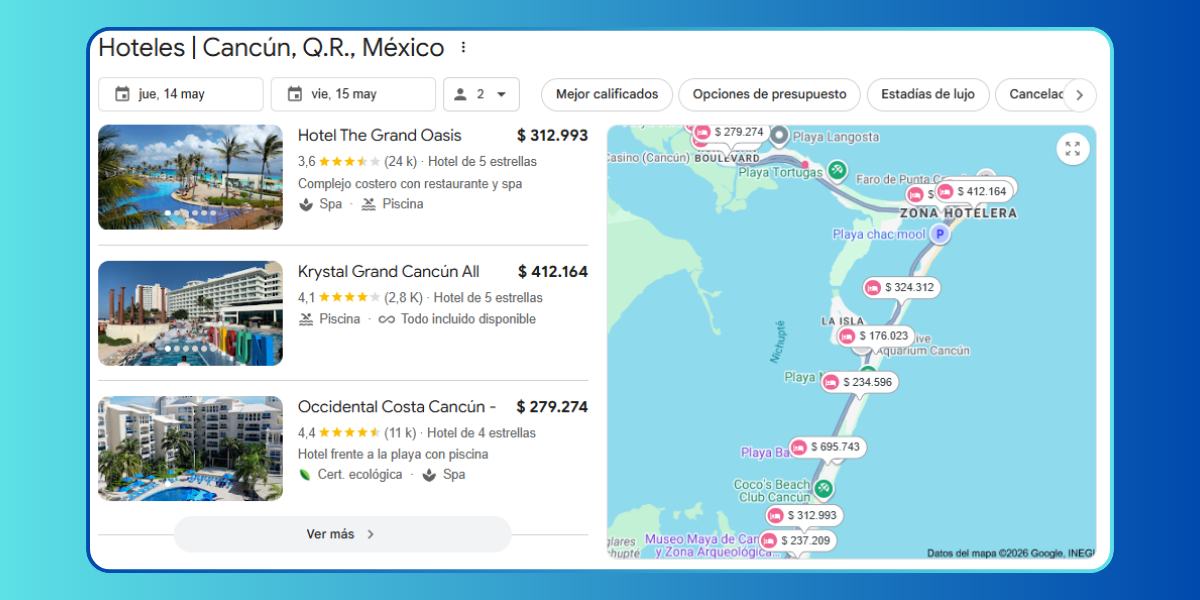
Google Hotels is the accommodation metasearch built into Google's ecosystem. Unlike an OTA such as Booking or Expedia, Google Hotels doesn't sell rooms or hold its own inventory. What it does is show travellers the options available for their dates and send them to the site where they can book — either an OTA or the property's own booking engine.
When someone searches "hotels in Madrid" or the name of a specific property, Google displays a module with a map, photos, reviews, filters and a price comparison. That comparison lists several sources (Booking, Expedia, Hotels.com, the hotel's own site, and so on) with their respective rates. The user picks one and clicks.
The important question is: how does your property show up inside that comparison? That's where Free Booking Links come in.
What travellers see on Google when searching for a place to stay
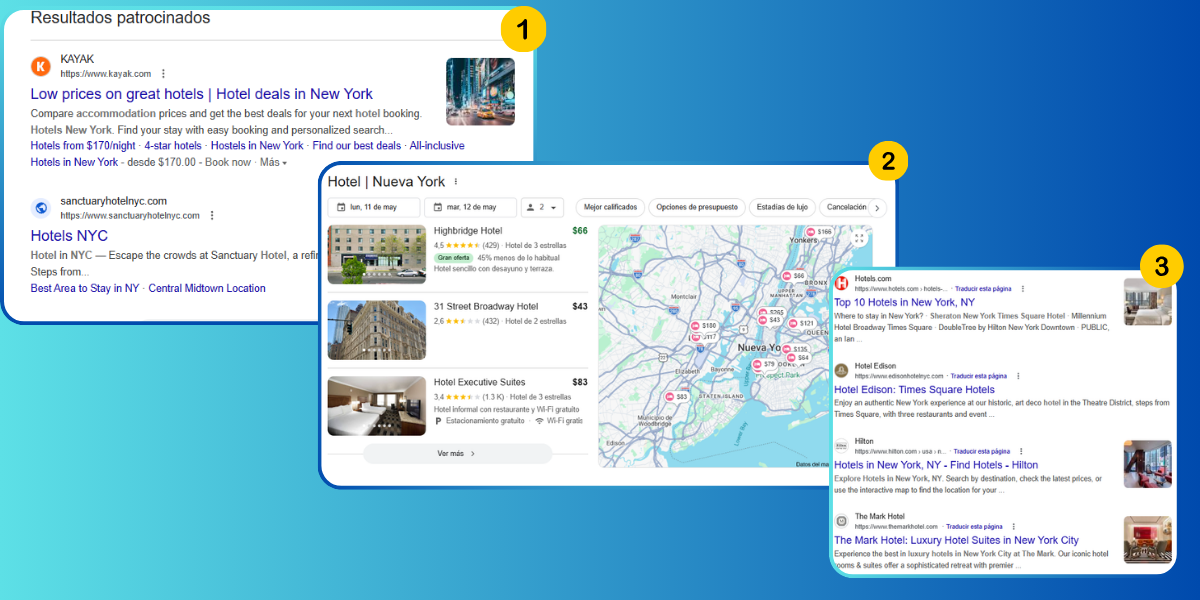
To understand where Google Hotels fits, it helps to review the visual order of a Google search. When someone types "hotel in [city]" from a browser, they usually see, from top to bottom:
- (1) Traditional Google Ads text ads, labelled "Sponsored".
- (2) The Google Hotels module, with map, properties and filters.
- (3) Organic (SEO) results from web pages.
If they search for a specific property name instead, what appears is the property information panel (on the right on desktop, below on mobile), with photos, details, reviews and a price comparison listing the different booking sources ordered by rate.
That comparison is the key moment: it's where the guest chooses between booking through an OTA or going to the property's own site.
What Google Free Booking Links are
Free Booking Links are the organic results inside Google Hotels. Your property appears in the price comparison with its direct rate and a link that takes travellers to your own booking engine — with no cost per click and no commission on the reservation.
Google launched them in 2021 with the aim of opening up metasearch to all kinds of properties, particularly independent ones that can't compete with large OTAs on advertising budget.
One useful detail: when the click goes to the property's own site, the link usually appears with the "Official site" label, which builds trust and sets you apart from the OTAs within the same comparison.
Google Business Profile: the foundation of your presence on Google
Google Business Profile (formerly Google My Business) is your free business listing on Google Search and Google Maps. It shows your name, address, photos, reviews, hours and website. It isn't the same as Google Hotels, but the two are closely linked.
When someone searches your property name, that listing is the first thing they see. And inside it, if your connection is active, the "Check availability" or "Compare prices" button appears, opening the Google Hotels module with your direct rate alongside the OTAs'.
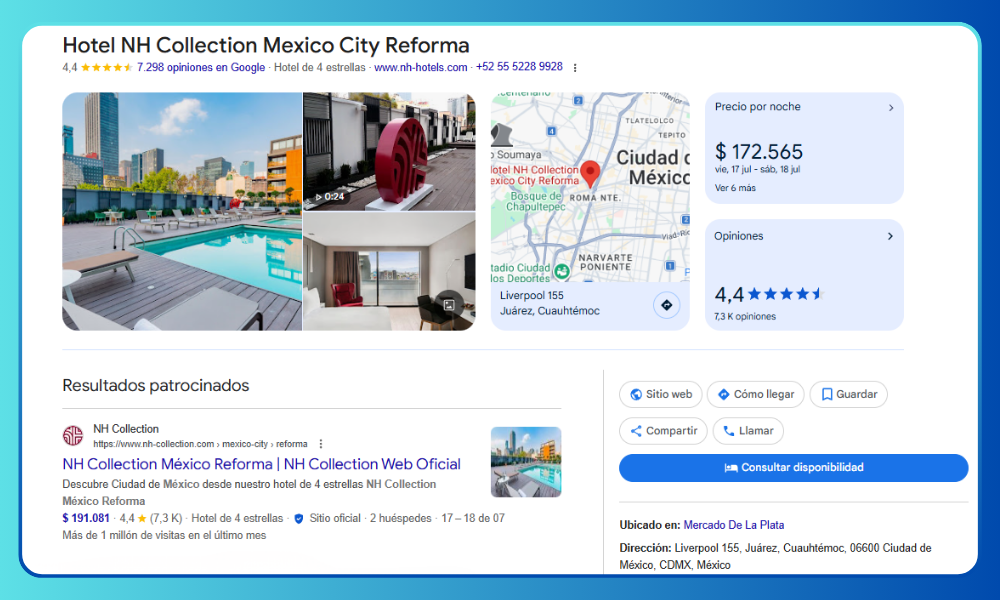
A well-maintained listing (professional photos, a complete description, active reviews, up-to-date hours, highlighted amenities such as "pet friendly" or "free WiFi") directly improves how your Free Booking Links perform: it's the context in which travellers decide whether to click. It also feeds into local SEO.
What Free Booking Links do for direct bookings
The main reason a small property should pay attention to this channel is direct bookings. The key benefits:
1. Lower commission costs
Every reservation that comes through your own site avoids the OTA commission, which typically ranges from 15% to 25%. With Free Booking Links there's also no cost per click and no commission, so whatever you bill through that channel comes in whole.
2. Visibility without a budget
Free Booking Links give you a place in the Google Hotels comparison without spending on advertising. For an independent property, it's one of the few ways to appear next to Booking or Expedia without competing on ad spend.
3. A direct relationship with the guest
Bookings through your own site mean guest data in your system, pre-arrival communication, upsell opportunities and a path to loyalty. OTAs limit or mediate all of that.
4. Control over the experience
Your booking engine, your brand, your terms. The traveller lands on your site, not on a third party's. That lets you offer packages, upgrades, extra services or exclusive rates you couldn't communicate through an OTA.
5. A level playing field
Before Free Booking Links, the Google Hotels comparison was almost exclusively the territory of OTAs with budget. Today, a well-connected hostel can appear right next to the big names.
Google Hotels vs OTAs: not competition, but complement
A common mistake is to think of Google Hotels as a replacement for OTAs. It isn't, and it's worth being clear about that to avoid building the wrong expectations.
OTAs remain essential for volume, international reach, mass marketing and the well-known "billboard effect": a traveller discovers your property on Booking, then searches the name on Google and lands on your direct site. Google Hotels doesn't replace that. What it does is give the guest a visible option to book direct, at the exact moment they're comparing prices.
A sensible strategy for a small property usually combines:
- OTAs to capture new demand, particularly international.
- Free Booking Links to capture the guest who already knows your property or is comparing prices.
- Google Business Profile as the base of your local presence and reputation.
- Your own website with a booking engine to close the direct sale.
Rate parity: the factor that decides the outcome
In the Google Hotels comparison, options are sorted mainly by price. If your direct rate shows up higher than Booking's or Expedia's, you'll sit at the bottom of the list and the connection loses its point. The user will click the cheapest option.
Google Hotels and AI search: where Gemini and AI Mode fit in
The way travellers search for accommodation is shifting again. Beyond typing "hotel in [city]" into the search bar, more people are asking an AI assistant directly for something like "find me a well-rated hotel for this weekend under USD 120". Google's AI Mode (powered by Gemini) and the Gemini app increasingly answer those queries with options, prices and live availability rather than a plain list of links.
What matters for your property: those AI answers don't invent the rates. When Gemini or AI Mode show hotel options with real-time prices, that data comes from the same Google Hotels feed described throughout this guide. In other words, the same connection that puts you in the price comparison is what makes you eligible to appear when a traveller asks an AI assistant where to stay.
The takeaway is consistent with everything above: one connection point, more places to appear. If your property already sends live rates and availability to Google, you're already feeding the source these AI experiences draw on, with no extra setup. If you're not connected, the AI assistant has no live data for your property and falls back on the sources that do.
At a glance: connected vs not connected
A quick comparison of what changes for a property depending on whether it sends live rates and availability to Google:
| Aspect | Connected to Google Hotels | Not connected |
|---|---|---|
| Visibility in the price comparison | Appears alongside the OTAs, with an "Official site" link to book direct | Absent from the comparison: only OTAs are shown |
| Rates and availability | Live and accurate, synced in real time | No direct rates shown for your property |
| Direct booking option | The guest books on your site straight from Google | The guest is routed to OTAs or has to search manually |
| Distribution cost | No cost per click and no commission on the direct booking | You depend on OTA commission, generally 15% to 25% |
| AI search (Gemini / AI Mode) | Eligible to appear when assistants show live options | No live data for AI; it relies on other sources |
| Guest relationship | Direct guest data, pre-arrival communication and upsell | Mediated by OTAs, with limited guest data |
What you need in order to connect
In practical order, here's what it takes for your property to appear on Google Hotels through Free Booking Links:
| Step | What you need | Why it matters |
|---|---|---|
| 1 | An active, complete and verified Google Business Profile | It's the foundation Google uses to identify your property |
| 2 | A Google connectivity partner that sends your rates and availability | Without that connection, Google can't display live data for your property |
| 3 | Rates and availability loaded at least 18 months ahead | Google queries distant dates: with no rate loaded, your property won't appear in those searches |
| 4 | A website with your own booking engine and rate parity | It's the destination of the click and where the direct sale closes |
| 5 | A system for measuring and attributing bookings | Without it you can't evaluate the channel's real return |
How to measure results
If you activate the connection, it's worth looking at metrics beyond "how many bookings came in through Google". A few useful reference points:
Clicks and impressions on Google
Free Booking Links come with their own visibility and click reporting. It's useful for understanding how often your property shows up in the comparison and what share of those impressions turns into visits to your site.
Attribution in your booking engine
Make sure your engine identifies bookings coming from Google Hotels (via UTM parameters or native integration). Without that, you can't tell a direct booking that arrived through organic search from one that came through the comparison.
Commission saved
Work out what you would have paid in commission if those same bookings had come through an OTA. It's the most concrete way to size up the channel's contribution.
Impact on total direct bookings
Watch how your channel mix evolves. If direct bookings grow after activating the connection, it's working, even if you can't attribute every reservation precisely.
Frequently asked questions
What are Free Booking Links?
They're the free booking links that appear in the Google Hotels price comparison. They show your direct rate alongside the OTAs' and send the traveller to your own booking engine, with no cost per click and no commission.
Is it free to appear on Google Hotels?
Yes, through Free Booking Links you can appear at no cost. What you need is a verified Google Business Profile and a connectivity partner sending your rates and availability to Google in real time.
How far ahead do I need to have rates loaded?
At least 18 months. Google queries availability for distant dates and only shows your property for those that have a rate loaded. If your rate calendar only runs six months out, you'll appear in that range of searches alone.
Which MiniHotel plans include the connection?
The Google Hotels connection is available on the Standard and Professional plans.
Does it work for short-term rentals?
Not at the moment. The connection is enabled for hotels, hostels and similar properties. If your operation combines both formats, get in touch and we'll review your case.
How long before my property shows up on Google?
Once the connection is complete and the property data is validated, Google runs a verification period before displaying rates in the comparison. Exact timing depends on Google and can vary by property, so it's worth checking at the point of activation.
Does Google Hotels replace OTAs?
No. It complements them. OTAs remain important for capturing new demand, particularly international. Google Hotels gives the guest a visible option to compare prices and book direct, reducing dependence on intermediaries.
What is rate parity and why does it matter?
Rate parity means your direct rate is equal to or better than the OTAs'. In the Google Hotels comparison, options are sorted by price: if your site looks more expensive than Booking or Expedia, the user will pick the cheaper option and the connection loses its effect.
In short
Google Hotels is no longer a novelty. It's now a standard part of the traveller's search journey and an increasingly relevant channel for direct bookings. For a small hotel or a hostel, appearing in that comparison with your own rate and a direct link changes the equation: the guest who already found you can book without going through an intermediary.
And it does so with no cost per click and no commission. Free Booking Links is, today, one of the most accessible ways to add visibility and direct bookings. The first step is always the same: get connected.
Want to connect your property to Google?
Message us on WhatsApp and our support team will walk you through activation — from verifying your Google listing to syncing your rates and availability.
Talk to support →